 The goal of synthesizing specific molecules by breaking and making bonds
at any desired site has been pursued for a long time. The ability
of using synchrotron radiation to excite core electrons to unoccupied
orbitals has created new possibilities for site-specific fragmentation.
A good example of a site-specific reaction is the photon stimulated ion
desorption from thin films of polymethyl methacrylate (PMMA).
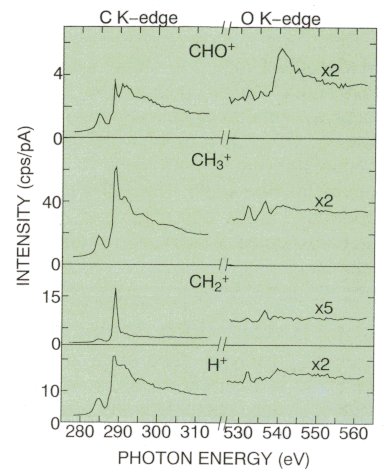
The photoion yield dependence with photon energy near the carbon and oxygen
K-edges for H+, CH2+,
CH3+ and CHO+ ions are shown.
This was measured by means of Ion-Time-of-Flight Mass Spectrometry.
It is observed that the production of different fragment ions involves
different transitions, and has different relative efficiencies.
The yield of different ion fragments depends on the specific electronic
transitions involved.
The goal of synthesizing specific molecules by breaking and making bonds
at any desired site has been pursued for a long time. The ability
of using synchrotron radiation to excite core electrons to unoccupied
orbitals has created new possibilities for site-specific fragmentation.
A good example of a site-specific reaction is the photon stimulated ion
desorption from thin films of polymethyl methacrylate (PMMA).
The photoion yield dependence with photon energy near the carbon and oxygen
K-edges for H+, CH2+,
CH3+ and CHO+ ions are shown.
This was measured by means of Ion-Time-of-Flight Mass Spectrometry.
It is observed that the production of different fragment ions involves
different transitions, and has different relative efficiencies.
The yield of different ion fragments depends on the specific electronic
transitions involved.
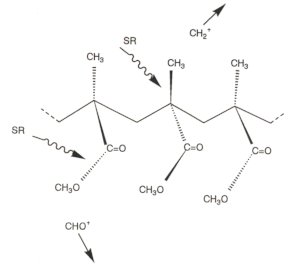 For the production of CH2+ ions it is more efficient to use carbon K-edge
excitation (C1s to s* state),
while for the production of CHO+ ions
it would be better to use oxygen K-edge excitation. It has been found
that site specific fragmentation of large molecules can be achieved by
tuning the excitation energy.
For the production of CH2+ ions it is more efficient to use carbon K-edge
excitation (C1s to s* state),
while for the production of CHO+ ions
it would be better to use oxygen K-edge excitation. It has been found
that site specific fragmentation of large molecules can be achieved by
tuning the excitation energy.
Photoion yield dependence on photon energy (top)
Photon stimulated ions from PMMA (bottom)