 on the magnetization of the material. These x-ray magnetic resonant
scattering techniques give information on the spin state of the magnetic
materials. These phenomena are much more informative than magnetic circular
dichroism, since the effective use of the polarization of the x-rays can
lead to clearer information on the spin states.
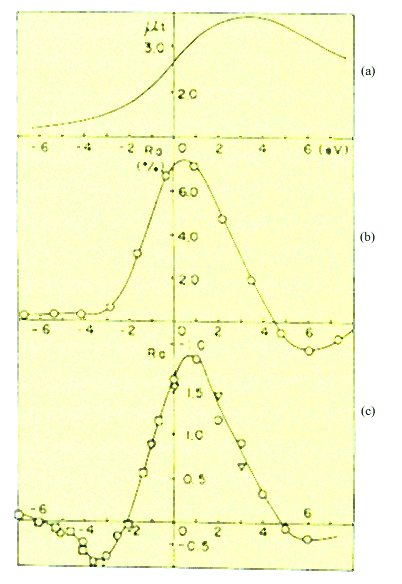
The figures (b) and (c) show the degree of asymmetry of the Bragg
reflection intensity, Ra = (I+ -I-)/ (I+ +I-), which arises
when the magnetic field applied to a Gd crystal alternates with
the incident x-ray energy tuned to the L3 absorption edge.
The figure (a) shows the absorption spectrum, (b) the asymmetry ratio
when the incident x-rays are in the horizontal polarization state and (c)
the asymmetry ratio in the case of 45 degree linear polarization.
The 45 degree polarization state reveals a peak at around -3 eV which is
evidence of the contribution of 4f levels by quadrupole scattering.
This can not be observed using horizontal polarization.
on the magnetization of the material. These x-ray magnetic resonant
scattering techniques give information on the spin state of the magnetic
materials. These phenomena are much more informative than magnetic circular
dichroism, since the effective use of the polarization of the x-rays can
lead to clearer information on the spin states.
The figures (b) and (c) show the degree of asymmetry of the Bragg
reflection intensity, Ra = (I+ -I-)/ (I+ +I-), which arises
when the magnetic field applied to a Gd crystal alternates with
the incident x-ray energy tuned to the L3 absorption edge.
The figure (a) shows the absorption spectrum, (b) the asymmetry ratio
when the incident x-rays are in the horizontal polarization state and (c)
the asymmetry ratio in the case of 45 degree linear polarization.
The 45 degree polarization state reveals a peak at around -3 eV which is
evidence of the contribution of 4f levels by quadrupole scattering.
This can not be observed using horizontal polarization.
(a) Absorption spectrum of Gd-L3 edge, (b) and (c) spectra of degree
of asymmetry of 004 Bragg reflection. Degree of asymmetry,
Ra, is defined as Ra=(I+ -I-)/ (I+ +I-) , where I+�@and I-�@
are the reflection intensities in the case of the two opposite directions
of the magnetic field. Linear polarization is (b) horizontal and (c) 45 degree.