Small-angle X-ray Diffraction and Solution Scattering
Small-angle X-ray diffraction and solution scattering techniques are used to
elucidate the relationship between the structure and the function of
constituent macromolecules in complex biological systems as these systems
evolve, eg. the mechanism of muscle contraction at the molecular level.

A small-angle X-ray diffraction pattern from contracting frog skeletal muscle
during isometric contraction in comparison with the muscle at a rest state
result. The upper figures show a pattern with the muscle in a rest state
(left) and in a contracting state (right) taken from the same muscle.
The lower image is a difference pattern of the upper two, clearly showing a
structural change in both actin and myosin filaments during contraction.
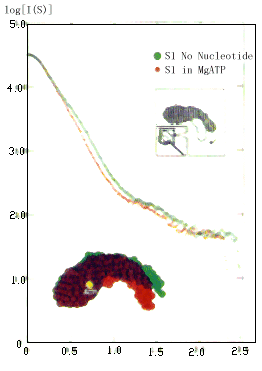
The change in the solution X-ray scattering profiles from myosin heads
isolated from myosin molecules in skeletal muscle with and without ATP in
solution. The myosin head is an energy transducing protein which hydrolyses
ATP in muscle contraction. The change in the scattering profile reveals a
distinct shape change in the myosin head during the hydrolysis of ATP, as
shown in the inset of B.
[PF Home Page]