Symmetry-Resolved Photoabsorption Spectroscopy
![]() Until now inner-shell spectroscopy of molecules has not been thoroughly
investigated because of the lack of intense excitation sources.
The advent of the undulator has changed this situation.
Undulator radiation is tunable, highly intense, and highly polarized.
Its combination with angle-resolved fragment-photoion measurements has
made it possible to decompose the photoabsorption spectra of diatomic
molecules into their molecular symmetry components.
Until now inner-shell spectroscopy of molecules has not been thoroughly
investigated because of the lack of intense excitation sources.
The advent of the undulator has changed this situation.
Undulator radiation is tunable, highly intense, and highly polarized.
Its combination with angle-resolved fragment-photoion measurements has
made it possible to decompose the photoabsorption spectra of diatomic
molecules into their molecular symmetry components.
![]() Photoabsorption strength is maximized when the incident
electric vector E is parallel
to the transition moment m.
For the
s -->
s (S type)
transitions the molecules oriented
parallel to E are selectively excited,
while for the
s -->
p (P type)
transitions those oriented perpendicular to E are
preferentially excited.
These molecular orientations are directly related to the angular
distribution of fragment photoions. The fragment-ion yield spectrum
for the direction parallel to E corresponds
to the S symmetry
component (sS),
and that perpendicular to E corresponds to
the P
symmetry component (sP).
Photoabsorption strength is maximized when the incident
electric vector E is parallel
to the transition moment m.
For the
s -->
s (S type)
transitions the molecules oriented
parallel to E are selectively excited,
while for the
s -->
p (P type)
transitions those oriented perpendicular to E are
preferentially excited.
These molecular orientations are directly related to the angular
distribution of fragment photoions. The fragment-ion yield spectrum
for the direction parallel to E corresponds
to the S symmetry
component (sS),
and that perpendicular to E corresponds to
the P
symmetry component (sP).
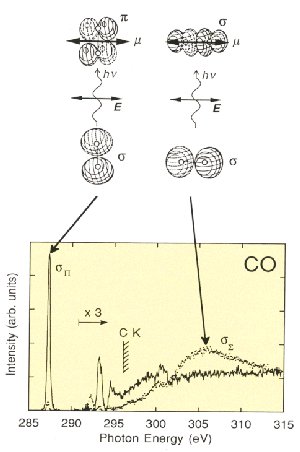 Photoabsorption spectrum of the CO molecule showing assignments.
[PF Home Page]